

If you ask a Nigerian with health insurance how they access care, you will find that their story starts long before they approach the reception desk at a medical service provider.
They have to contend with finding an accredited provider, understanding what their health plan covers, obtaining treatment authorisations at the hospital, figuring out how to access specialist care without travelling long distances, and navigating administrative processes while already dealing with the anxiety of being unwell.
None of these challenges are clinical in nature, yet they shape healthcare experiences just as profoundly as the quality of care itself.
As conversations about the future of healthcare increasingly focus on medical breakthroughs, artificial intelligence and new treatment models, there is another question we should be asking: How easy is it for people to access the care that is currently available to them today?
I believe that question will define the next phase of healthcare in Nigeria.
Access is Becoming Healthcare’s Next Frontier
Nigerian healthcare has entered the experience economy because, as with services in sectors such as finance, consumers increasingly expect transparency, intuitiveness and responsiveness. Today, people can transfer money instantly, track international deliveries in real time and access financial services from virtually anywhere. As a result, it is unsurprising that they now expect healthcare to offer the same level of convenience. Yet, this is an industry where service delivery often remains characterised by uncertainty, fragmented processes and avoidable delays.
For organisations operating on the access facilitation side of healthcare, this presents both a challenge and an opportunity.
Health insurers have traditionally been viewed as organisations that finance healthcare access. Increasingly, however, our role extends much further. We are becoming access enablers, helping people navigate the healthcare system with greater ease, confidence and transparency.
That evolution demands a different understanding of responsiveness. In this context, it is not simply about speed; it is about designing systems that reduce friction, provide clarity and ensure that people spend less time navigating processes and more time receiving care.
Responsiveness is a Shared Responsibility
It is important, however, to recognise that responsiveness does not rest with any single organisation because healthcare is an ecosystem.
Hospitals deliver care, doctors and other healthcare professionals provide clinical expertise, laboratories conduct diagnostics, and Health Maintenance Organisations (HMOs) facilitate access while removing administrative barriers as best they can. Patients, understandably, experience this as one continuous journey. They rarely distinguish between delays caused by workforce shortages, hospital capacity or administrative processes. To them, it is simply “the healthcare experience.”
Nigeria’s healthcare system faces well-documented structural challenges, including one of the lowest doctor-to-patient ratios in the world. According to Nigeria Health Watch, our doctor-to-patient ratio stands at just 2.9 doctors per 10,000 people, equivalent to roughly one doctor for every 3,474 people, far below the World Health Organization’s recommendation of 17 per 10,000. Many healthcare providers across the country, both private and public, are managing overwhelming patient volumes with limited human resources. Waiting times for consultations, diagnostics and specialist services are therefore often driven by clinical capacity rather than administrative delays alone.
Recognising these realities is not about assigning blame. It is about understanding where meaningful improvements can, and should, be made.
HMOs cannot eliminate every challenge within the healthcare system; no single player can. They cannot increase the number of doctors overnight or expand hospital capacity through technology alone. What they can do is ensure that administrative processes never become an additional obstacle to care.
For an HMO, responsiveness is measured by questions such as these: How quickly can providers obtain treatment authorisations? How transparent is the approval process? Can customers easily understand their benefits? Can they access medical guidance without unnecessary travel? Can routine enquiries be resolved immediately, allowing healthcare professionals to focus on clinical care?
These are the questions that increasingly define the quality of healthcare access, and the solutions need not be complicated. Currently, our regulator, the National Health Insurance Authority (NHIA), mandates that HMOs must authorise treatment and issue pre-authorisation codes within one hour of receiving a request from a healthcare provider, demonstrating that the need for greater responsiveness is increasingly recognised across the industry.
At Avon HMO, we are already ahead of the curve. In 2025, we made it possible for our members to receive approvals for secondary care requests within nine minutes. We call this our “9-Minute Promise”, and more than 80% of our approvals meet this threshold, with the remaining 20% comprising more complex cases that require additional review. In addition, our average call answer time at our contact centre is seven seconds.
Technology Should Remove Friction, Not Add to It
Too often, discussions about healthcare technology focus on innovation for its own sake. But technology creates value only when it makes healthcare easier to access.
Telemedicine offers a clear example. In many situations, patients do not necessarily need to visit a hospital before speaking with a qualified medical professional. Virtual consultations can reduce unnecessary hospital visits, shorten waiting times for routine cases, keep hospital facilities available for those who need them most and extend healthcare access to people in underserved communities.
Artificial intelligence offers similar opportunities. Beyond automation, AI can help customers receive faster responses to routine enquiries, support better decision-making, and enable healthcare organisations to anticipate customer needs before they become service issues. At Avon HMO, the launch of Ava, our WhatsApp chatbot, was driven by this objective.
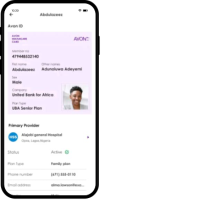
Today, mobile apps like AvonFlex help HMO users access a broad range of healthcare services independently, from telemedicine and gym session bookings to requesting medications for prescriptions unavailable at hospital pharmacies, scheduling wellness checks, tracking pre-authorisation approvals, processing refunds for emergency healthcare expenses, finding nearby healthcare providers and much more.
Data also has an increasingly important role to play. Better insights can help strengthen provider networks, identify service bottlenecks and improve resource allocation across the healthcare ecosystem.
Collectively, these innovations allow healthcare professionals to spend more time delivering care by reducing the administrative burden surrounding it.
A Broader Responsibilty for Health Insurers
At Avon HMO, this understanding continues to shape how we approach innovation. Digital tools are not viewed as ends in themselves but as enablers of better healthcare access. Whether through mobile apps, telemedicine, AI-enabled customer support, digital plan management or faster authorisation workflows, the objective is consistent: remove unnecessary friction between customers and the care they need.
Equally important is helping customers better understand how the healthcare journey works.
One common misconception is that every delay experienced within a hospital falls under the responsibility of the HMO. In reality, healthcare delivery involves multiple stakeholders working together. While health insurers are responsible for facilitating access and processing approvals efficiently, waiting times within hospitals may also reflect provider capacity, clinical priorities or workforce constraints.
Improving healthcare experiences, therefore requires transparency from every participant in the ecosystem, alongside better public understanding of how these different responsibilities intersect.
Trust grows when expectations are clear, processes are transparent and customers know what is happening at every stage of their journey.
Building a More Responsive Healthcare System
Nigeria’s healthcare challenges are too complex for any single organisation to solve. Improving healthcare access will require stronger collaboration between policymakers, providers, health insurers and technology companies. It will require continued investment in healthcare infrastructure, workforce development and digital innovation. However, it will also require a shift in mindset.
The future of Nigerian healthcare will not belong solely to organisations that deliver excellent clinical outcomes. It will belong to those that make quality healthcare easier to reach, easier to navigate and easier to trust. For health insurers, that represents an evolving responsibility.
We are no longer simply financing healthcare. We are helping shape how millions of people experience access to it. And in a healthcare system where every unnecessary delay increases anxiety and every unnecessary barrier discourages treatment, there may be no more meaningful innovation than making access simple, seamless and human-centred.